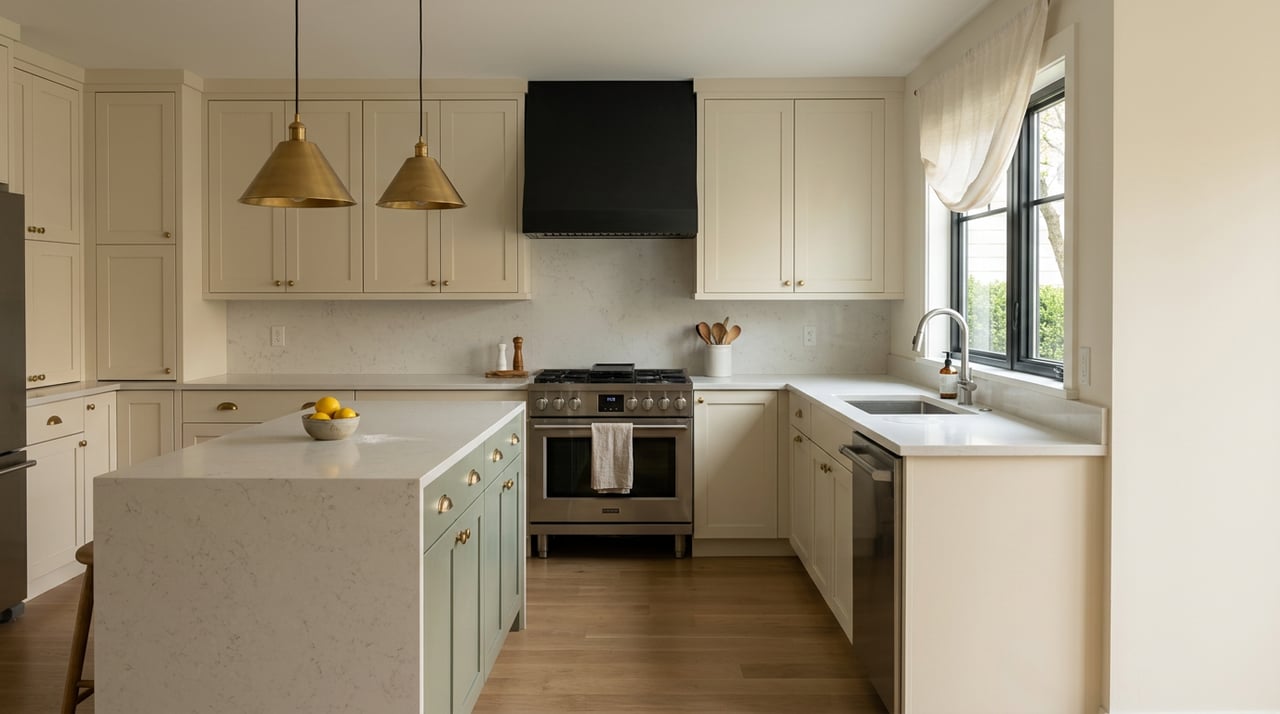
Fishers' Median Home Price Is Hiding Three Different Markets
August 20, 2026
August 20, 2026
A buyer scanning Fishers listings this month will see two numbers that should not both be true. The median sale price is up. The average time it takes a home to sell is up too, nearly double what it was a year ago. In most markets, rising prices and slowing sales point in opposite directions: one says demand is winning, the other says buyers are gaining room to wait. Fishers is doing both at once, and the reason has nothing to do with the market cooling. It has to do with which Fishers you're shopping in.
In the three months ending May 2026, the median sale price in Fishers was $427,000, up 1.7 percent from the same period a year earlier. That is the number that shows up in every portal search and every casual conversation about whether Fishers is "still hot." It suggests a market holding steady, maybe cooling slightly at the edges.
But over that same window, the average Fishers home took 20 days to sell, up from 12 days a year prior. Sales volume actually rose, with 460 homes sold in May compared to 407 the year before. More homes changed hands, at higher prices, and it took longer to close each one. A single median price cannot explain that combination. It can only average it away.
Zoom into the most recent snapshot and the picture gets stranger still. As of June 2026, only 274 homes were listed for sale in Fishers, down nearly 13 percent from a year earlier, with new listings that month down more than 31 percent year over year. That is a resale market with almost nothing new coming onto the shelf. If inventory is that scarce, why would anything take longer to sell?
A veteran Hamilton County agent described the region on a July 2026 industry podcast in terms that cut through the confusion better than any spreadsheet. She called it "almost three separate real estate markets," and the description holds up against the data.
A blended median cannot show you which of these three markets a specific listing belongs to. It just averages a fast luxury sale, a slow middle-tier standoff, and a scarce starter-home bidding war into one deceptively calm number.
The middle tier is under pressure from two directions that rarely get mentioned together.
The first is demand. Fishers has spent the last several years adding the kind of employer that pulls relocating households straight into the $400,000 to $600,000 range. Andretti Global broke ground on its motorsports headquarters in December 2022, a project the city describes as a $200 million investment expected to create up to 500 jobs by 2026. Stevanato Group's pharmaceutical packaging facility in the Fishers Life Science and Innovation Park represents another $140 million and roughly 250 high-wage positions. These are not entry-level jobs. They are the kind that come with relocation packages and a search that starts squarely in move-up single-family territory.
The second is a supply story that looks like it should help but mostly doesn't reach that price band. Thompson Thrift's Fishers District, a $750 million, 123-acre master-planned project that broke ground back in 2015, is now in its final phase. The Union, anchored near Interstate 69 and 116th Street, is bringing 251 apartment homes, a 135-room AC Hotel by Marriott, and new restaurant tenants including Piedra and Niku Sushi.Kitchen.Bar, with completion expected late 2026. Slate at Fishers District, a 242-unit build-to-rent community of villas and townhomes, finished construction in May 2024 and had already crossed 90 percent occupancy within about a year of opening. The Crossing is home to the Fishers Event Center, a 7,500-seat arena hosting the Indy Fuel, Indy Ignite, and Fishers Freight.
All of that is real investment and real rooftops. Almost none of it is for-sale single-family inventory in the $400,000 to $600,000 range. It absorbs renters and short-term residents, but it does nothing to relieve the resale shortage that first-time and move-up buyers are actually competing over. Meanwhile, downtown redevelopment keeps reinforcing why people want to be here at all: Browning Investments announced a $157 million mixed-use project along 116th Street designed to preserve longtime tenants like Nickel Plate Bar & Grill and Roman and Leo while adding new residential, retail, and a boutique hotel, and the Nickel Plate Trail's pedestrian bridge over 96th Street, which opened in early 2026, now gives Fishers a direct trail connection into Indianapolis. Every one of these projects makes the case for living here stronger. None of them adds a $450,000 resale listing to the market.
That mismatch, rising job-driven demand against a resale supply that is shrinking rather than growing, is what stretches days on market in the middle tier even while the overall median keeps climbing. Sellers in that band are pricing for a market that still looks tight on paper. Buyers in that band have started waiting a little longer, comparing more, and pushing back on price in ways they were not doing two years ago.
If you are searching in the $400,000 to $600,000 range, the headline median is not your market. Your competition is other buyers targeting the same job-driven relocation wave, and your leverage comes from the fact that homes in this specific band are sitting longer than the county average suggests. It is worth asking a listing agent directly how long that particular home has been active, not just trusting a citywide number.
If you are selling in that same band, pricing to last year's fast-moving comps is the most common mistake right now. A listing priced for a 12-day market in a 20-day middle tier will sit long enough to draw a price reduction, which then becomes its own signal to buyers that something is off, even when nothing is.
If you're shopping above $600,000, the top-of-market pace described in local agent conversations is closer to what you'll actually experience. Expect less negotiating room and be ready to move when the right home appears.
Does a rising median mean Fishers home values are guaranteed to keep climbing? No single quarter of data supports a guarantee in either direction. The 1.7 percent increase reflects a specific three-month window and a specific mix of homes that sold in it, not a forecast.
Will the wave of new construction eventually bring prices down in the middle tier? Only if that construction is for-sale single-family product in the $400,000 to $600,000 range specifically. Most of the recently completed and in-progress Fishers District development is rental housing, which affects who lives here more than what resale buyers can choose from.
Is downtown Fishers behaving differently than the rest of the city? Yes, and increasingly so. The concentration of new hospitality, dining, and trail access around the Nickel Plate District is a different value proposition than a subdivision several miles out, even when both carry a similar list price.
Reading a market by its median is a little like judging a neighborhood by its average commute time. It tells you something happened, not what it felt like to any one household. If you're trying to figure out which of Fishers' three markets your search actually belongs to, that's a conversation worth having before you write an offer, not after.
Courtney Walsh Baisa works Hamilton County's luxury, new-construction, and move-up markets every day, including the middle-tier friction most portal searches miss. Let's Connect to talk through what your specific price range looks like right now.
Stay up to date on the latest real estate trends.

Luxury real estate demands strategy, precision, and insight. With a data-driven approach, expert marketing, and a deep understanding of buyer behavior, every step is designed to maximize results and deliver a seamless, elevated experience.