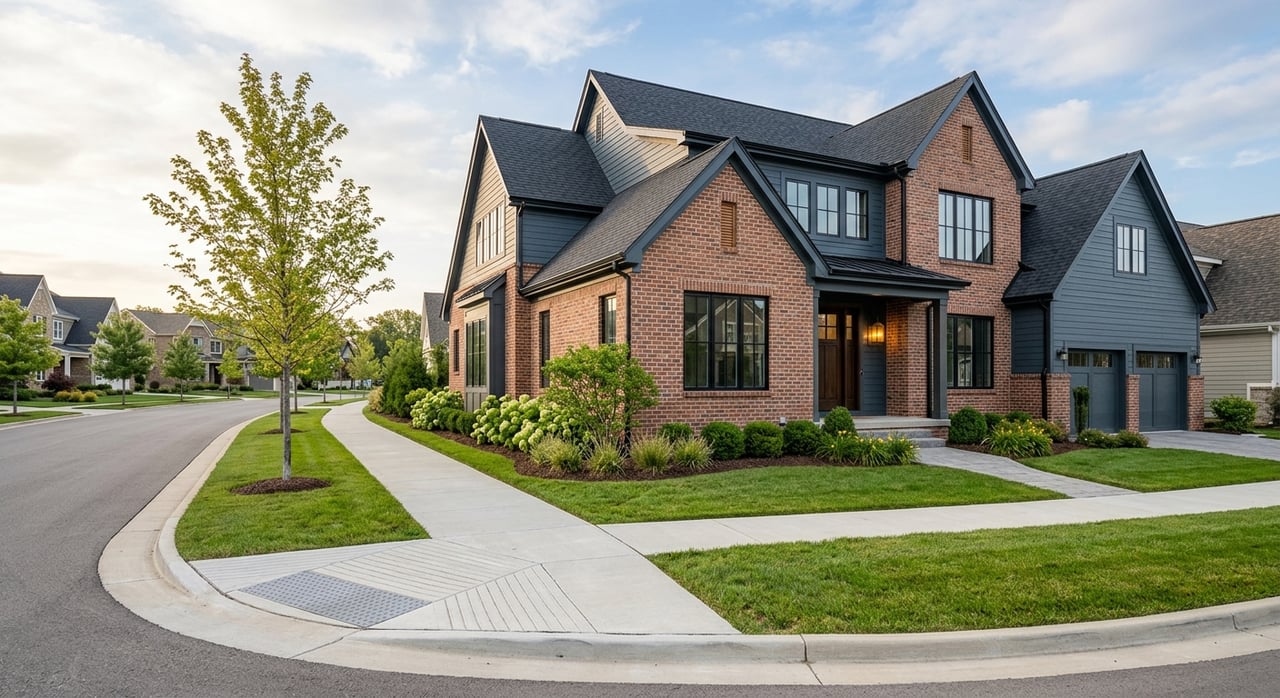
Why Whitestown Indiana Real Estate Growth Stands Out
July 9, 2026
July 9, 2026
If you have been watching northwest Indy and wondering where the real momentum is, Whitestown deserves your attention. This is not just a suburb with future potential. The numbers show it is already growing fast, adding housing, and building the infrastructure to support what comes next. If you are thinking about buying, building, or making a move in Boone County, this breakdown will help you see why Whitestown is on so many buyers’ radar. Let’s dive in.
Whitestown is not waiting to become a hot suburb. According to U.S. Census Bureau estimates, the town reached 15,767 residents as of July 1, 2025, which is a 53.4% increase from 2020. By comparison, Boone County grew 14.0% over the same period to 80,689 residents.
That gap matters because it shows Whitestown is outperforming the broader county around it. When one town is growing that much faster than its neighbors, it usually points to a strong mix of housing demand, new development, and buyer interest.
Local planning also supports the same story. A 2024 Whitestown impact-fee analysis projected population growth from 16,295 in 2024 to 32,547 by 2033. For housing, the same report projected growth to 8,008 equivalent housing units for planning purposes.
Whitestown’s demographic profile helps explain why the town is drawing interest. Census data shows 30.7% of residents are under 18, the owner-occupied housing rate is 69.6%, and the median owner-occupied home value is $373,500. Median household income is $123,643, and 62.7% of residents hold a bachelor’s degree or higher.
Taken together, those numbers suggest a market that appeals to many move-up buyers, professionals, and households looking for a suburban setting with newer housing options. It also points to a community where ownership remains a major part of the housing mix.
For buyers comparing Boone County options, Whitestown also appears to sit in an appealing price band. Realtor.com market data shows a median listing price of $399,500 in Whitestown, while Zionsville is listed much higher at $790,000. That relative difference can make Whitestown especially attractive for buyers who want northwest Indy access and newer homes without pushing into a much higher price tier.
One of the clearest signs of a hot suburb is whether population growth is actually turning into homes on the ground. In Whitestown, the answer is yes. The town’s 2023 annual report says it issued 564 total new residential permits, including 492 single-family detached permits, which was the highest detached-home total the town had ever issued in a single year.
That is a meaningful signal for buyers and sellers alike. It shows the market is not just active in theory. It is producing a large volume of new homes, which can create more options for buyers and more competition around pricing, features, and builder incentives.
The pipeline has stayed active beyond that snapshot. In July 2024, the Whitestown Plan Commission gave a favorable recommendation for Enclave at Whitestown, a 16.8-acre development proposing 56 single-family residential lots and 54 new-build homes, along with two existing homes folded into the project.
There is also evidence that the town’s product mix is broadening. That same month, the commission supported a rezoning request for about 20.66 acres tied to New Hope Christian Church to allow mixed-use commercial, office, and residential zoning. That kind of land-use shift often signals a market maturing beyond standard suburban expansion.
If you think Whitestown is only about subdivisions, the latest development activity suggests otherwise. The 2025 Padgett Commons agreement outlines a mixed-use district with residential, retail, senior living, and entertainment uses.
Project materials include a four-story mixed-use multifamily building with 42 residential units and 15,000 square feet of retail, a three-story multifamily building with 78 residential units, an 80-unit senior living facility, and an 82,000-square-foot entertainment facility. The agreement also references about $25.7 million in public infrastructure costs, $31.2 million in project investment, and another $46 million in contemplated private capital.
This matters because it shows Whitestown’s growth story is becoming more layered. Instead of relying only on detached housing, the town is also adding denser residential formats and commercial activity that can support a more connected day-to-day lifestyle.
A growing suburb also needs buyers who are willing to absorb inventory. Current housing portal data suggests Whitestown continues to move at a healthy pace, even though each platform measures the market a little differently.
Realtor.com shows Whitestown with a $399,500 median listing price, 200 homes for sale, and a median 34 days on market. Zillow reports an average home value of $364,483, 64 homes in inventory, and homes going pending in around 19 days as of May 31, 2026. Redfin reports a median sale price of $379,673, 140 homes sold in May 2026, and a median 34 days on market.
The exact numbers vary, but the pattern is consistent. Whitestown appears to be an active market where homes are still getting attention and inventory is moving.
One reason some fast-growing suburbs struggle is that roads, utilities, and public services can lag behind housing demand. Whitestown’s recent capital activity suggests the town is working to stay ahead of that issue.
In November 2024, Whitestown announced a $14 million expansion of its wastewater treatment plant. The project increased capacity from 1.7 million gallons per day to 2.3 million gallons per day, and the town said the added capacity should support growth for the next 5 to 10 years.
That kind of utility investment may not be flashy, but it is important. For buyers and builders, it signals that local planning is tied to real growth needs rather than just optimistic projections.
Transportation investment is also significant. Whitestown’s 2025 to 2030 Capital Improvement Program identifies 9 road and intersection projects plus 7 multi-use path projects, with an estimated total cost of $174.6 million and about $41.6 million in estimated five-year funding.
That funding gap is worth noting because it shows both ambition and pressure. The town is clearly planning for continued growth, but the scale of transportation demand is also substantial.
Whitestown’s location along the I-65 corridor remains a major part of its appeal. In June 2023, INDOT and the town highlighted a $62.9 million project that built diverging diamond interchanges at I-65 and SR 267, as well as I-65 and CR 550 South near Whitestown, with the goal of improving safety and traffic flow.
More recently, in March 2026, INDOT awarded Whitestown $2,273,600 for improvements at Whitestown Parkway and CR 525 E. The funding supports roundabout enhancements as phase one of the Whitestown Parkway project.
The town also received an $80,000 Safe Streets and Roads for All planning grant to create a roadway safety plan. For residents, these projects are not just line items on a report. They shape commute patterns, access, and how manageable growth feels over time.
A hot suburb is not just about rooftops and roads. Buyers also want parks, trails, and everyday amenities that make a place feel livable. Whitestown’s amenity base has been expanding alongside its housing growth.
The town says it maintains more than 50 acres of parks and more than 13 miles of trails. Its new-residents information also notes more than 12 miles of trails and says Whitestown has about two times more trail mileage per resident than most nearby communities.
Whitestown also states that it is served by Zionsville Community Schools and Lebanon Community School Corporation, with private-school options available. For buyers evaluating location fit, that helps clarify the public school district context without treating one option as better than another.
Parks investment is continuing as well. In March 2026, Whitestown announced the groundbreaking for Maurer Commons Park, a 14-acre park on the west side of I-65 with plans for a splash pad, playground, basketball court, pickleball courts, an amphitheater, and open greenspace.
The most accurate answer is that Whitestown already looks like one of northwest Indy’s hotter suburbs. It has posted very strong population growth, supported a large new-construction pipeline, invested in utilities and transportation, and continued building out parks and mixed-use amenities.
That does not mean every part of the market will move the same way or that growth will be friction-free. Fast-growing towns often face pressure around traffic, timing, inventory mix, and infrastructure funding. Still, the data shows Whitestown is not running on hype alone.
If you are considering Whitestown, the key is to approach it strategically. In a market shaped by new construction, mixed product types, and fast local change, it helps to look beyond surface-level buzz and evaluate pricing, builder quality, resale positioning, and timing with a clear plan.
Whether you are buying your first move-up home, comparing Boone County options, or watching where northwest Indy growth is headed next, Whitestown is a market worth taking seriously. If you want a smart, data-backed plan for navigating Whitestown and nearby north-side suburbs, connect with Courtney Walsh Baisa.
Stay up to date on the latest real estate trends.
Luxury real estate demands strategy, precision, and insight. With a data-driven approach, expert marketing, and a deep understanding of buyer behavior, every step is designed to maximize results and deliver a seamless, elevated experience.